Dystopia: A Natural History by Gregory Claeys
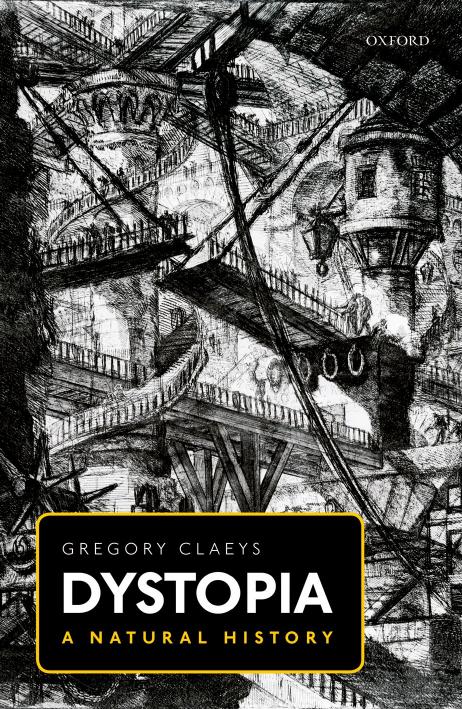
Author:Gregory Claeys
Language: eng
Format: epub, pdf
Publisher: Oxford University Press
Published: 2016-11-03T16:00:00+00:00
Science Fiction and Dystopia
Further problems arise from describing dystopian literature as a branch of science fiction. Though lunaria, or imaginary voyages to the moon, were already common in the seventeenth century, the utopian genre precedes that of science fiction by some four centuries.42 The term ‘science fiction’ was not evidently used before 1851.43 Often dated from Mary Shelley’s Frankenstein (1818), the genre proliferates only in the late nineteenth century, and remains intermixed with other forms of narrative.44 By the late twentieth century, however, science fiction became so popular as to swallow up nearby genres, including, by 1950 or so, both utopia and dystopia combined; hence the tendency to back-date this process.45
Yet some authors have concluded that, leaving Wells aside, ‘there has been very little overlap between science fiction and utopia’, but considerably more between science fiction and anti-utopia (instancing Huxley, Orwell, Vonnegut, and Pohl and Kornbluth).46 W. Warren Wagar notes that much science fiction has ‘only a peripheral interest’ in those questions of social and political organization which are often central to utopia and dystopia.47 Most science fiction is not collectivist in orientation, in Patrick Parrinder’s view, Wells here being the exception rather than the rule.48 Many studies of science fiction also explicitly ignore texts we would regard as dystopian, though H. Bruce Franklin, for instance, defines The Iron Heel as science fiction and Looking Backward as a novel about time travel. From a utopian viewpoint, this seems odd; why not call More’s Utopia a travel book? (It was once read this way, in the Mandeville tradition.) Bellamy’s book is about projected alternative societies where ‘time travel’ is a literary device which enables the projection. It has no scientific import as such. Any similar device which performs the same function of distancing or estrangement, providing a critical distance from the present—a key aim of these genres—would have sufficed.49
Many commentators thus separate utopia, dystopia, and science fiction on broadly realist grounds. Kingsley Amis describes science fiction as ‘that class of prose narrative treating of a situation that could not arise in the world we know, but which is hypothesised on the basis of some innovation in science or technology, or pseudo-science or pseudo-technology, whether human or extra-terrestrial in origin’.50 This indicates a ‘realist’ criterion of genre separation, if relative to time and place. (Near-future texts are invariably more realistic.) And it remains, as Parrinder reminds us, also relative to real science itself, which, it is sometimes claimed, is rarely portrayed in the genre with any degree of accuracy.51 In both cases, the advancement of science moves themes from the domain of science fiction to that of utopia/dystopia as their possibility becomes realizable. What is crucial is that science is central to the narrative, as Darko Suvin indicates: ‘An S-F narration is a fiction in which the S-F element or aspect is hegemonic—that is, so central and significant that it determines the whole narrative logic, or at least the over-riding narrative logic, regardless of any impurities that might be present.’52
Thus there are
Download
Dystopia: A Natural History by Gregory Claeys.pdf
This site does not store any files on its server. We only index and link to content provided by other sites. Please contact the content providers to delete copyright contents if any and email us, we'll remove relevant links or contents immediately.
4 3 2 1: A Novel by Paul Auster(12352)
The handmaid's tale by Margaret Atwood(7725)
Giovanni's Room by James Baldwin(7293)
Asking the Right Questions: A Guide to Critical Thinking by M. Neil Browne & Stuart M. Keeley(5734)
Big Magic: Creative Living Beyond Fear by Elizabeth Gilbert(5721)
Ego Is the Enemy by Ryan Holiday(5383)
The Body: A Guide for Occupants by Bill Bryson(5061)
On Writing A Memoir of the Craft by Stephen King(4909)
Ken Follett - World without end by Ken Follett(4701)
Adulting by Kelly Williams Brown(4549)
Bluets by Maggie Nelson(4533)
Eat That Frog! by Brian Tracy(4497)
Guilty Pleasures by Laurell K Hamilton(4416)
The Poetry of Pablo Neruda by Pablo Neruda(4077)
Alive: The Story of the Andes Survivors by Piers Paul Read(4009)
White Noise - A Novel by Don DeLillo(3987)
Fingerprints of the Gods by Graham Hancock(3974)
The Book of Joy by Dalai Lama(3957)
The Bookshop by Penelope Fitzgerald(3826)
